The Great Filter: Why Big Rounds Are Harder to Raise in the Age of AI
Venture capital is at record highs, yet fewer startups win big rounds. AI makes building fast and cheap, so investors now back what is hard to copy, safe to adopt and cheap to run.
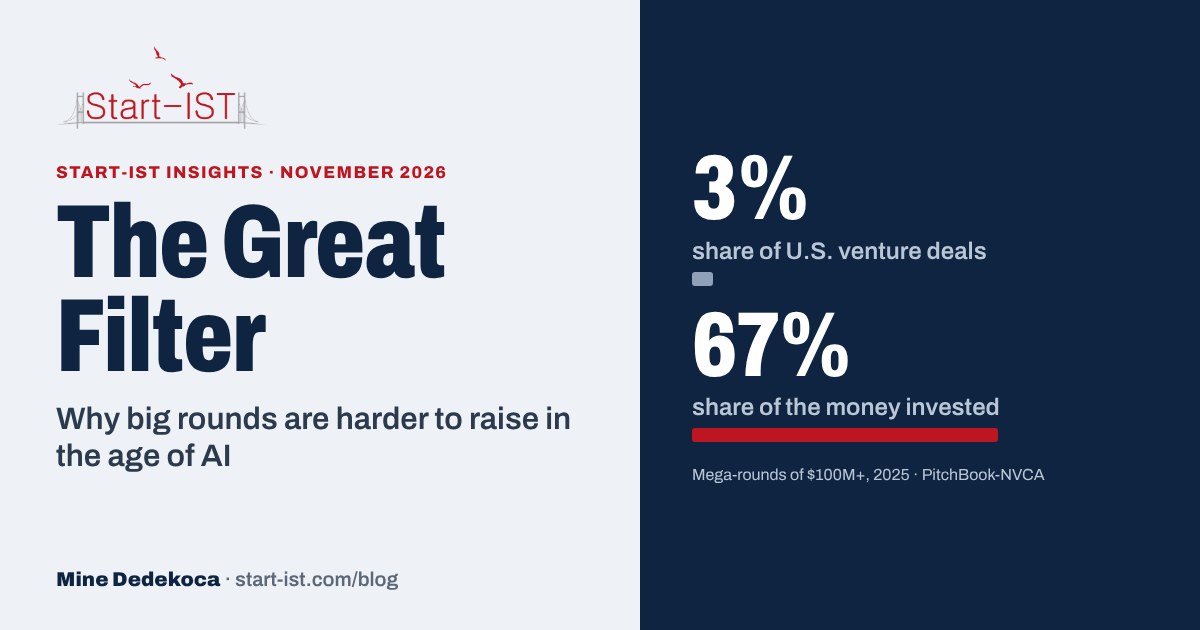
Venture capital has never had more money, yet for most founders a big round has rarely been harder to win. In the first nine months of 2026, U.S. startups raised a record $515.8 billion, and AI companies took 82.7% of it (PitchBook-NVCA, via SiliconANGLE). Globally, just 27 companies collected about a third of the $159 billion invested in Q3 2026 (Crunchbase, via Metir).
The problem is not a shortage of capital. It is a change in what capital is willing to buy. AI lets a small team build in weeks what once took a funded company a year. That speed is a gift to founders and a warning to investors: if you can build it fast, so can everyone else.
So investors are concentrating on a narrower set of companies: those that are hard to copy, hard to replace, safe to adopt and cheap to run. Here is the data behind that shift and what it means for founders, especially in Türkiye.
More money, fewer winners
The 2026 boom is real, but it is narrow. PitchBook notes that without the OpenAI and Anthropic rounds, U.S. totals have followed roughly the same trend since late 2024 (SiliconANGLE). Strip out 2025’s $100M+ deals and the rest of the market was about $105 billion, “comparable to 2019 or early 2020” (NVCA 2026 Yearbook).
The gap between the grey and navy bars is the story: a minority of deals collects most of the capital, and the gap widened in 2026.
The squeeze runs up the chain to the investors themselves. In 2026, U.S. megafunds of $500 million or more took 78% of new fund capital while being 6% of funds. Only 211 emerging managers closed a fund, against 927 in 2022 (SiliconANGLE). Fewer small funds means fewer people writing the first cheques young companies need.
The global picture is similar. In Q3 2026, seed rounds got $13 billion of the $159 billion invested, and $2.6 billion of that went to seed rounds of $100 million or more (Crunchbase, via Metir).
AI makes building cheaper and faster
AI has collapsed the cost and time of turning an idea into revenue. Stripe found its top 100 AI companies reached $1 million in annualised revenue in a median 11.5 months, four months ahead of the fastest SaaS companies of the previous era. Lovable hit $17 million in annual recurring revenue in three months; Bolt hit $20 million in two (Stripe).
Companies also need far fewer people to get there.
Solo founders started 36.3% of new U.S. startups in the first half of 2025, up from 23.7% in 2019 (Carta Solo Founders Report). A June 2026 working paper by Hyunjin Kim (INSEAD) and Rembrand Koning (Harvard Business School) found AI-native startups are 25% smaller than comparable peers, at similar valuations (Sovereign Magazine).
For founders, this is good news: a small cheque now buys a real product. For investors, it changes the maths. If a small team can reach revenue cheaply, a large round is no longer needed to prove an idea. And an idea that is cheap to build is also cheap for someone else to rebuild.
When building is cheap, copying is cheap
The tools that let one founder ship a product in a weekend let a competitor rebuild it the next weekend. Investors call the most exposed companies “wrappers”: an interface on top of someone else’s model, with no data, workflow or distribution of their own.
The threat is not only rival startups. SignalFire’s Ryan Wexler argues that a product built around a current model weakness can become a free feature in the next model release. His test is whether a layer of the stack will still exist in ten years (SignalFire).
The repricing of easily replaced software is already visible. Bending Spoons bought Airtable for $1.3 billion, against an earlier $11.7 billion valuation. Miro is expected to sell for $1.4 billion after a $17.5 billion Series C. Shares in companies that last raised in 2021 trade at a median 59% discount on Forge Global’s secondary market (SiliconANGLE).
So the first question in a pitch meeting has changed. It is no longer “Can you build it?” Almost anyone can. It is “Why can’t anyone else?”
What investors now pay for
When anything can be built quickly, capital moves to what cannot be copied quickly. In 2026 investor commentary, five traits keep coming back:
- A problem that outlasts the model. The product becomes more valuable, not obsolete, when AI gets ten times better (SignalFire).
- Data that compounds with use. Data created as a by-product of customers using the product, which no competitor can download.
- A system-of-record position. Owning the workflow, the integrations and the messy, regulated parts of an industry.
- Trust and safety. Compliance, reliability and data sovereignty that a raw API cannot offer. In Türkiye, Cerebrum Tech built an AI system for Doğa Sigorta that keeps insurance data inside the country (Daily Sabah).
- Capital efficiency. High revenue per employee and gross margins that survive model inference costs.
The bar to reach the next round shows how selective this has become.
The traction expected has risen too. Cowboy Ventures’ Aileen Lee told the Wall Street Journal that a startup raising a Series A is now expected to show $4–5 million of revenue in its first year (Sovereign Magazine). The median gap between seed and Series A was 2.1 years in Carta’s 2025 data, up from 1.5 years in 2019 (SaaStr on Carta).
What this means for founders in Türkiye
Türkiye feels the filter even more sharply. Startups raised $172 million across 87 rounds in the first half of 2026, and six companies took 75% of it. Gaming alone took $111.4 million, while fintech fell from $220.4 million in all of 2025 to $16.6 million (startups.watch, via Daily Sabah).
AI is still waiting for its breakout here. In the same half-year, 33 Turkish AI startups raised $28.6 million combined. In the UK, seven AI companies took 49% of $16.1 billion. Logo Software founder Tuğrul Tekbulut calls the local gap the “waiter-height” problem: too big for seed investors, too small for international growth funds.
That makes defensibility even more important for Turkish founders. Before you raise, test your company against these questions:
- Could a two-person team with AI tools rebuild your product in a month? If so, what can’t they copy: data, contracts, licences, distribution?
- Does your product get better or worse when the next model ships?
- What data does only your product generate?
- Are you in a trust-heavy setting, such as finance, health, defence or public services, where local presence, compliance and data residency matter?
- What are your revenue per employee and gross margin after AI costs?
- Can you reach revenue before the big round, so you raise from strength?
- Is Türkiye a launchpad to a larger market, such as Europe or the Gulf, from day one?
The bottom line
Capital has not disappeared; it has become selective. AI rewards founders who build fast, then punishes those whose speed is their only advantage. In 2026, big rounds go to companies that are hard to copy, safe to adopt and cheap to run.
The good news is that these traits can be designed in early. Start-IST has supported founders since 2012, from idea stage to investment and scale-up, and represents the Global Startup Awards in Türkiye. If you are preparing a round, we can help you stress-test your defensibility story and meet the right investors. Get in touch.
References
- Riley, D. “US venture deal value reaches record $515.8B as exits fail to keep pace.” SiliconANGLE, 8 October 2026 (PitchBook-NVCA Venture Monitor, Q3 2026). siliconangle.com
- National Venture Capital Association. “NVCA 2026 Yearbook: The Venture Industry in Transition.” NVCA / PitchBook, 2026. nvca.org
- Axios. “Axios Pro Rata,” 8 October 2026 (AI share of 2026 U.S. deal count). www.axios.com
- Metir. “Q3 2026 Venture Funding: $159B, AI at 64%, 27 Mega-Rounds,” 6 October 2026. www.metirai.com
- Crunchbase News. “Q3 2026 global startup funding” report, 5 October 2026. news.crunchbase.com
- Stripe. “Indexing the AI economy.” stripe.com
- Lemkin, J. “The Real State of Seed Today: The Top 10 Learnings from 50,000 Startups, Per Carta’s Latest Data.” SaaStr, 12 December 2025. www.saastr.com
- Walker, P. and Shad, H. “Solo Founders Report 2025.” Carta, 9 December 2025. carta.com
- Kim, H. and Koning, R. Working paper on AI-native startups. INSEAD / Harvard Business School, June 2026. www.hbs.edu
- Sovereign Magazine. “AI Startups Are Staying Small by Hiring Fewer Junior Staff,” 24 September 2026. www.sovereignmagazine.com
- Wexler, R. “Moats are for castles: Why AI startups should optimize for permanence, not defensibility.” SignalFire, 4 May 2026. signalfire.com
- Venture Capital Careers. “Seed to Series A Graduation Rate: The Data and How VCs Use It,” 23 October 2026. venturecapitalcareers.com
- Sırt, T. “Türkiye attracts $172 million in startup funding in H1.” Daily Sabah, 10 July 2026 (startups.watch data). www.dailysabah.com